Skip to content

AI is moving quickly in healthcare. New tools, new use cases, new expectations. For many teams, the opportunity is clear. So is the responsibility.
But applying governance, regulation and safety standards in practice is not always straightforward. The frameworks exist, but interpreting them and knowing what to do next can feel like a different challenge altogether.
In the teams we work with, that often shows up as hesitation. People are wary of getting something wrong, so they hold back. There can be a sense that if you commit something to paper and it is not perfect, it will come back to cause problems later.
In reality, the opposite is usually true. Clear, well-reasoned decision-making, even if it evolves over time, is far more likely to stand up than silence or guesswork.
At the same time, many teams worry they are missing something fundamental. They assume the bar is higher or more complex than it really is, when in practice they are often already meeting key requirements without realising it.

The challenge is not a lack of effort or intent. It is a lack of confidence in how to interpret and apply what is already there
Daniel Mannion,
Director of Professional Services

What we started to notice
Through our work with organisations across the health tech ecosystem, we have seen a consistent pattern.
Teams are not short of information. What they are often missing is clarity. The same questions come up again and again, regardless of the size or stage of the organisation.
- What is the EU AI Act, and does it apply to what we are building?
- What are the practical steps we should be taking day to day to prevent data breaches?
- What level of risk assessment does the NHS actually expect for software like ours?
These are not edge cases. They sit underneath real decisions about design, deployment and safety.
As AI continues to develop, that gap is becoming more visible. The pace of innovation is increasing, but the ability to confidently apply governance alongside it is not always keeping up.
In many cases, it is not about introducing new frameworks. It is about helping people work with what already exists, in a way that is proportionate, practical and grounded in their context.
From being asked, to building something
Before 8fold Training existed as a platform, we were already being asked for help in a different way.
Clients and partners wanted training. Not high-level overviews, but practical guidance they could use within their teams. This became especially clear around data protection and, more recently, with the introduction of the EU AI Act.
As a team, we have all worked in healthcare and health tech. We have seen how important clear, well-designed training is, and how difficult it can be to access if you are not directly embedded within healthcare delivery.
When the EU AI Act introduced a requirement for organisations to ensure their staff are AI literate, we developed and released an AI literacy course to support that need. We made it freely available, and within a few weeks, hundreds of people had signed up, including entire teams within some of the organisations we work with.
That response told us something important. This was not a one-off request. It reflected a much wider need for accessible, practical education.
It also raised a further question. Much of the training available in this area is designed to get people to a certificate. We wanted to do something different. The aim was not just completion, but understanding. Something that would genuinely help people make better decisions in practice.
Why sharing this knowledge matters
Our core work at 8fold is hands-on and tailored. We work closely with organisations to navigate complex regulatory and governance challenges. But many teams are earlier in their journey. They are building, testing and exploring, and they still need access to reliable, practical guidance.
At the same time, the landscape can be difficult to navigate. There are multiple frameworks and standards to consider, and it is not always clear which ones apply, or where to find trusted information. Even when guidance exists, it is often written for regulatory specialists rather than the teams doing the work.
That combination of demand and inaccessibility creates a gap.
Our mission is to put safety, ethics, and good governance at the heart of healthcare innovation, because we believe health technology can make a meaningful difference in people’s lives when it is developed and delivered safely and equitably.
Even if all we do is help someone understand how to apply best practice in a practical way, and make their product safer or better as a result, that is something we want to be part of.
That raised a practical challenge. How do you take what you learn through hands-on work, and make it accessible in a way that more teams can actually use?

Introducing 8fold Training
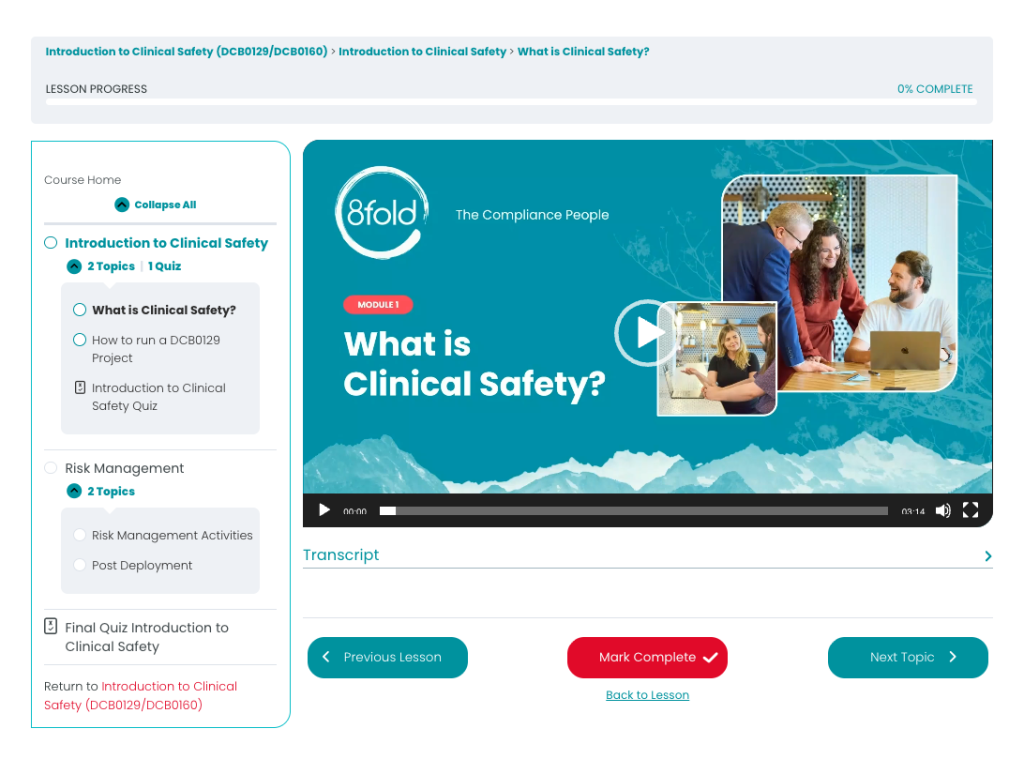
It brings together the areas we are most often asked about into a single platform. The focus is on making complex requirements easier to understand and apply, so teams can make informed decisions and move forward with confidence.
The platform includes modules on AI literacy, medical device regulation, clinical safety standards and data protection. It is designed to be practical, accessible and grounded in real-world application.
We will continue to build on this over time, reflecting the standards and frameworks teams are working with every day.
Who this is for?
8fold Training is designed for teams who are actively working with new technologies and trying to understand what is required of them.
That includes early-stage and scaling health tech companies, as well as teams within the NHS who are engaging with AI-enabled tools in practice.
If you are building, testing or implementing technology and want clearer guidance on how to approach governance and compliance, this is designed to support you.


What this makes possible?
When teams have access to clear, trusted guidance, it changes how they work.
We have already seen this in practice. One organisation used the platform to bring its entire workforce up to speed on AI compliance, supporting its journey towards ISO 42001 certification. Others have highlighted how the training helped them better understand governance requirements and identify practical steps to make their systems safer, often by putting simpler, more effective controls in place.
That is where the value sits. Not in completing a course, but in being able to apply what you have learned in a way that improves the quality and safety of what you are building.
It makes decisions easier to navigate. It reduces uncertainty. And it gives teams a clearer sense of how to move forward with confidence.
Ultimately, that leads to better outcomes. Not just for organisations, but for the patients and healthcare systems these technologies are designed to support.
An open invitation
8fold Training is now available, including our AI literacy course module. We are also providing free access for certain models to NHS users, supporting clinicians and teams as they engage with AI in practice.
If you’re building or deploying AI in healthcare and want a clearer way to approach governance, compliance and safety, 8fold Training is a practical place for you and your team to start learning at your own pace.
Need help educating your team or levelling up your knowledge?
Learn more about our healthcare compliance curriculum, developed based on the decades of experience within the 8foldGovernance team