

Ambient Voice Technologies have been quickly and quietly growing in popularity across the NHS over the past few years following the explosion of generative AI and Large Language Models across the world.
This was in response to findings that numerous AVT solutions were not compliant with the guidance provided by NHS England, which includes specific reference to the UK Medical Device Regulations.
However, despite recognition of the value and advocation for use of these tools by frontline healthcare professionals, some suppliers have now fallen foul of guidance published by NHSE on the appropriate regulatory classification and compliance requirements of these technologies.
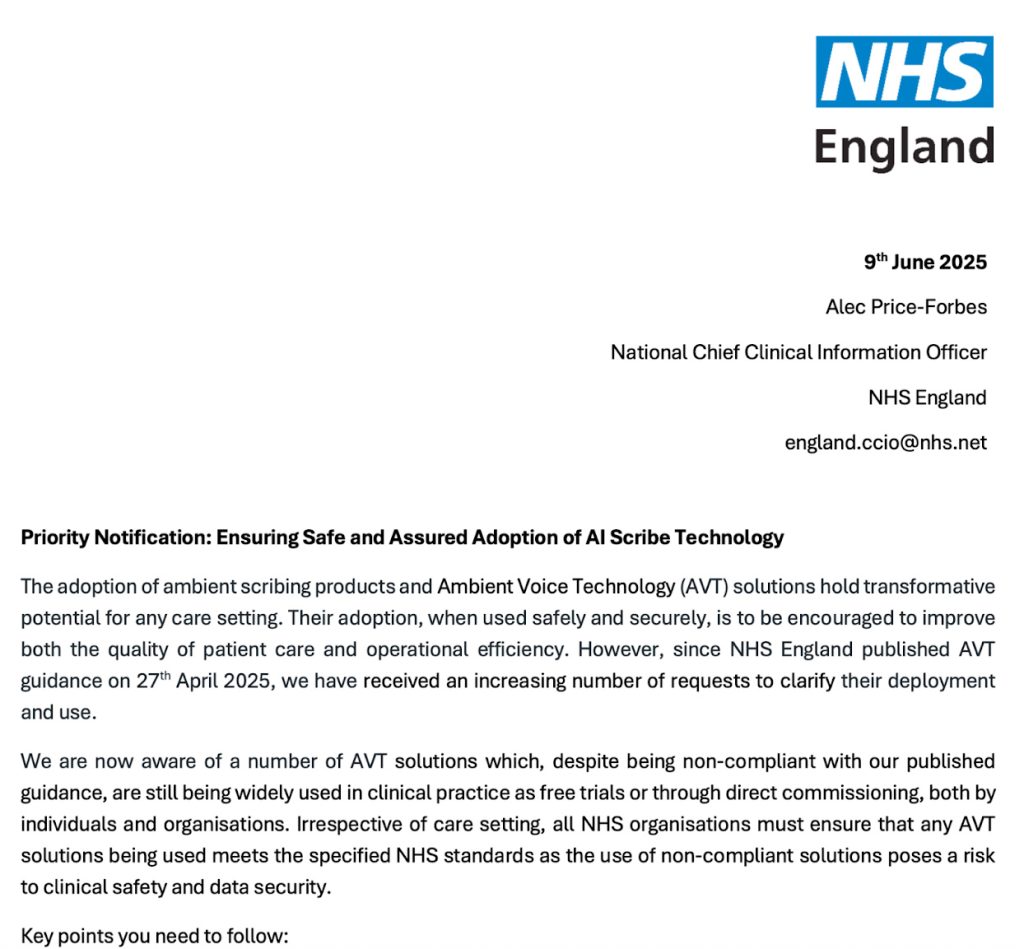
On the 9th June, the Chief Clinical Information Officer for England, Alec Price-Forbes, issued a letter to suppliers and NHS providers about compliance requirements for Ambient Voice Technologies (AVTs), building on earlier guidance published by the centre on the 27th April 2025.
We understand at 8fold that interpreting Medical Device Regulations and NHS compliance requirements can sometimes be ambiguous and misleading, so we wanted to help suppliers understand the relevance of these compliance requirements to accelerate adoption for the triple benefit of patients, clinicians and the wider healthcare system.
In this blog, we will unpack:
- The compliance requirements for Ambient Voice Technologies in the NHS
- The nuances of Medical Device Regulations for AVT technologies in the UK, Europe and the US
Compliance Requirements for Ambient Voice Technologies in the NHS
As laid out in the guidance and minimum requirements for AVT adoption, all suppliers must comply with the NHS Digital Technology Assessment Criteria (DTAC), with the main pillars requiring evidence of compliance with:

DCB0129, with a Clinical Safety Officer that holds a professional registration

GDPR & the NHS Data Secuirty Protection Toolkit (DSPT)

Data Protection Impact Assessment (DPIA) signed off by the deploying organisation

Cyber Essentials Plus

CREST Approved Penetration Testing
Some technologies may also need to comply with the Medical Device Regulations, specifically where the technology undertakes summarisation activities that go beyond basic transcription or dictation. If the product does summarisation, it falls under Class 1 as a self-decalred medical device in the UK. If it provides any further diagnosis, management plan, referral or calculation, it could be a Class IIa device requiring approval by an Approved or Notified Body.
If you would like to learn more about compliance requirements in the UK for Digital Health solutions, you can find out more in our comprehensive guide: https://8foldgovernance.com/all-about-digital-compliance-in-uk-healthcare/
Medical Device Regulations for AVT
There have been numerous calls by industry commentators for Ambient Scribes to be regulated as Medical Devices due to the ‘scope creep’ of the products to provide summarisation and Clinical Decision Support. However, due to the difference in risk classifications in the United States (where these technologies are not considered a Medical Device) and unspecific guidance from the MHRA, many suppliers have failed to identify that their technology is in fact a regulated product.
Some time ago, the MHRA published Guidance on medical device stand-alone software including apps (including IVDMDs) where it was made clear that:

if the software/ app performs a calculation or interprets or interpolates data and the healthcare professional does not review the raw data, then this software may be considered a medical device.

For the most part, Ambient Voice Technologies conducting summarisation of consultations and then providing structured outputs into a clinical record, may be considered Medical Devices in the UK.
However, MHRA’s February guidance on Digital Mental Health Technology further elaborated on their position (although it’s not clear why this was only given in a product-specific guidance document). This guidance explains the types of functionality and purposes the MHRA considers medical device functionality (depending on its purpose), including any processing of data “with an algorithm that is not easily verifiable”.
The release of the updated guidance in July 2026, further clarified the boundary of when an AVT or AI Summarisation feature should be considered as a Medical Device. The guidance, which includes a set of structured examples, makes it clear that software using AI to summarise existing clinical information, for the purpose of review by a trained clinician, is unlikely to qualify as a medical device. Products which generate new insights or diagnostic indications, or which do not require a clinician review of the summary, may still be medical devices and should be reviewed in more detail against the guidance.
It’s also a similar case for Europe, the guidance document MDCG 2019-11 associated with the EU Medical Device Regulation (MDR), details:
Software which is intended to process, analyse, create or modify medical information may be qualified as a medical device software if the creation or modification of that information is governed by a medical intended purpose.
By virtue of the fact that AVT can summarise documentation, this puts it squarely in scope of EU MDR.
However, in the US, the provisions of the 21st Century Cures Act and the FDA’s guidance on Clinical Decision Support Software creates a regulatory environment where tools intended to make recommendations to healthcare professionals that meet four criteria (not for signal acquisition; displays, analyses or prints medical information; supporting a healthcare professional; healthcare professional can assess the basis of the recommendation) are not considered Medical Devices on the US market.
Very similar guidance also exists for the Canadian market.
Whats next for Ambient AI?
With this letter and a renewed focus on safety, trustworithiness and compliance, the AVT market is definitely set for a tumultuous period. Those who have been ahead of the curve on compliance are likely to benefit in the form of access to opportunities, whilst those slower to accept the changes may fall at the way side.
We’ve already seen this following the boom of digital health apps which entered the market post-COVID, with many of them now having to address compliance as an after thought, or even consider transitioning to being a medical device because of AI-based functionality they want to offer.
Whats clear is that Ambient AI will not be the first category to fall foul of the regulations for SaMD.
One thing we know for certain is that this communication from NHSE, alongside the openness of many suppliers to share their regulatory and compliance status, is a promising sign of how AI can be adopted at scale across the NHS with regulatory compliance as a key indicator of safety and performance.

Building AI for Healthcare?
If you’re building Ambient AI for healthcare and are concerned about whether you meet the requirements to do business in the NHS, we would love to help.
Get in touch for a FREE, no-obligation review of your product and compliance documentation. We’ll help you get from where you are, to where you need to